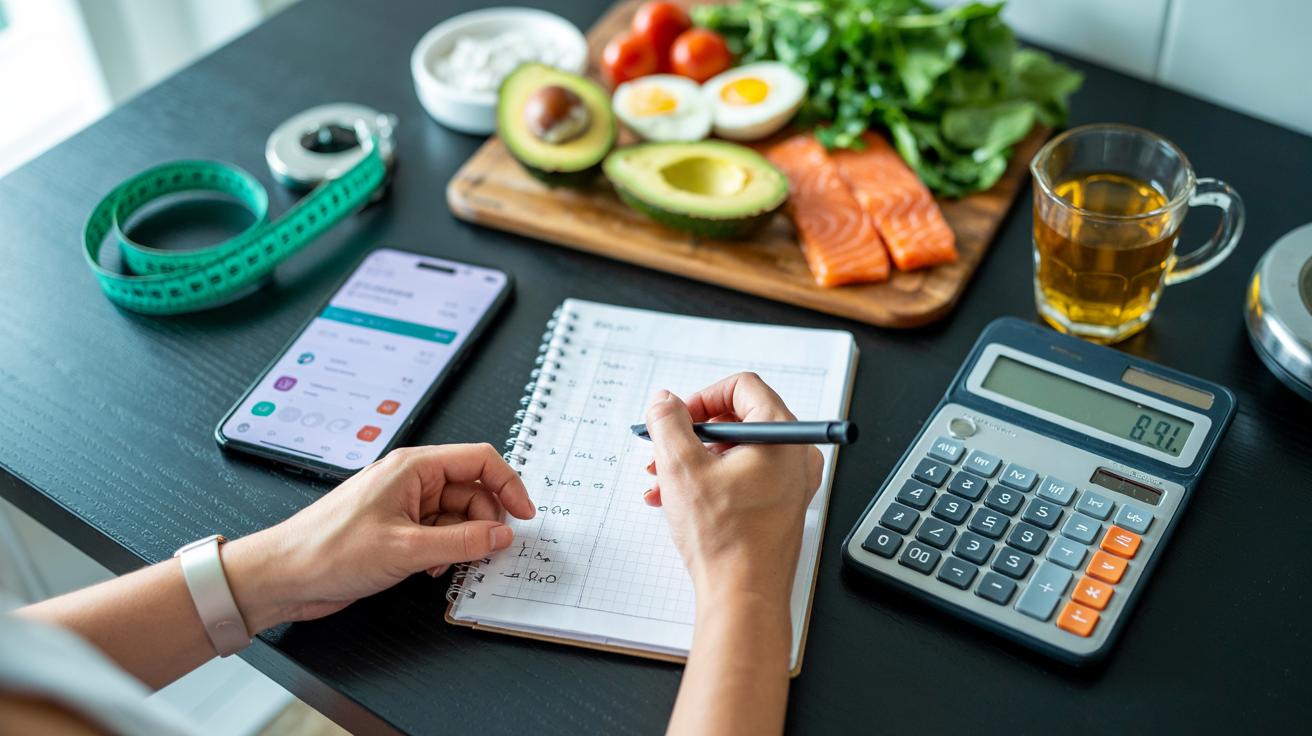
When I first started keto three years ago, I was completely overwhelmed by all the percentages, ratios, and numbers. Learning how to calculate keto macros seemed impossibly complex. Honestly, I almost gave up before I even began! But after coaching hundreds of clients through their keto journeys (and going through my own 65-pound transformation), I’ve developed a foolproof system for calculating your keto macros that actually makes sense.
Trust me, if I could figure out how to calculate keto macros (math was never my strong suit), you absolutely can too. So let’s break down how to calculate keto macros in simple, actionable steps that you’ll be able to use today to transform your keto experience.
What Are Keto Macros and Why Calculating Them Matters
Macros (or macronutrients) are the nutrients your body needs in large amounts: proteins, fats, and carbohydrates. On a ketogenic diet, you dramatically reduce carbs, moderately increase protein, and significantly increase fat intake.
When I first heard about the keto macro ratio, I thought “this can’t be right… all that fat?” But here’s the thing – these specific ratios are what trigger ketosis, the metabolic state where your body burns fat for fuel instead of glucose (sugar).
The standard keto macro breakdown looks something like this:
- Fat: 70-80% of daily calories
- Protein: 20-25% of daily calories
- Carbs: 5-10% of daily calories (typically 20-50g net carbs)
But these percentages don’t tell the whole story. When you learn how to calculate keto macros properly, you’ll see that your individual needs depend on several factors like your weight, height, activity level, and goals. That’s why generic advice often fails – your macros should be personalized to YOU.
Why Personalized Macros Make All the Difference
I remember working with Sarah, a client who had tried keto multiple times without success. She was following generic macro recommendations she found online, but they weren’t calibrated to her specific situation.
After we learned how to calculate keto macros properly for her specific situation (which ended up being quite different from what she’d been following), she dropped 8 pounds in the first two weeks and finally started seeing the results she wanted.
The right macro balance is like having the correct combination to a lock – when it’s precise, everything just clicks into place. Your energy improves, cravings diminish, and weight loss becomes much more effortless.
How to Calculate Keto Macros: The Step-by-Step Method
Alright, let’s get into the actual calculation process. I’m going to break this down into manageable steps. Grab a calculator and something to write with… let’s do this!
Step 1: Calculate Your Basal Metabolic Rate (BMR)
Your BMR is the number of calories your body needs just to perform basic functions like breathing and keeping your heart beating. Think of it as your body’s minimum operating cost.
For women, the formula is: BMR = 655 + (4.35 × weight in pounds) + (4.7 × height in inches) – (4.7 × age in years)
For men, the formula is: BMR = 66 + (6.23 × weight in pounds) + (12.7 × height in inches) – (6.8 × age in years)
I know these formulas look intimidating, but let’s work through an example. For a 40-year-old woman who is 5’6″ (66 inches) and weighs 180 pounds:
BMR = 655 + (4.35 × 180) + (4.7 × 66) – (4.7 × 40) BMR = 655 + 783 + 310.2 – 188 BMR = 1,560.2 calories
This means her body needs about 1,560 calories daily just to maintain basic functions.
Step 2: Determine Your Total Daily Energy Expenditure (TDEE)
Your TDEE accounts for your activity level beyond basic bodily functions. Multiply your BMR by the appropriate activity factor:
- Sedentary (little or no exercise): BMR × 1.2
- Lightly active (light exercise 1-3 days/week): BMR × 1.375
- Moderately active (moderate exercise 3-5 days/week): BMR × 1.55
- Very active (hard exercise 6-7 days/week): BMR × 1.725
- Extremely active (athlete, 2x training/day): BMR × 1.9
Using our example, if she’s lightly active: TDEE = 1,560.2 × 1.375 = 2,145.3 calories
This represents her maintenance calories – what she needs to maintain her current weight.
Step 3: Set Your Calorie Goal Based on Your Objectives
Now, adjust your calories based on your goals:
- For weight loss: Reduce by 15-25% (multiply TDEE by 0.75-0.85)
- For maintenance: Keep at 100% TDEE
- For weight gain: Increase by 10-20% (multiply TDEE by 1.1-1.2)
For our example, if weight loss is the goal with a 20% deficit: Calorie Goal = 2,145.3 × 0.8 = 1,716.2 calories
I usually round to the nearest 10, so that’s 1,720 calories per day.
Step 4: Calculate Your Keto Macros in Grams
This is where we convert percentages into actual grams of food. Here’s the standard keto breakdown:
- Carbohydrates: 5-10% of calories (I typically recommend starting at 5%)
- Protein: 20-25% of calories
- Fat: The remaining 65-75% of calories
Remember:
- Carbs and protein each contain 4 calories per gram
- Fat contains 9 calories per gram
Let’s calculate for our example with a 5%/20%/75% split:
For carbs (5%): 1,720 × 0.05 = 86 calories ÷ 4 = 21.5g of carbs
For protein (20%): 1,720 × 0.2 = 344 calories ÷ 4 = 86g of protein
For fat (75%): 1,720 × 0.75 = 1,290 calories ÷ 9 = 143.3g of fat
So our macros would be approximately 22g carbs, 86g protein, and 143g fat per day.
One quick note – when tracking carbs for keto, you’ll want to focus on net carbs (total carbs minus fiber), as fiber doesn’t significantly impact blood sugar levels.
How to Adjust Keto Macros for Different Goals
The beauty of the ketogenic approach is its flexibility. You can modify your macro ratios depending on your specific goals.
How to Set Your Keto Macros for Weight Loss
For most people looking to lose weight on keto, I recommend:
- Carbs: 5-10% (keep under 20-25g net carbs to start)
- Protein: 20-25% (at least 0.8g per pound of lean body mass)
- Fat: 65-75% (enough to feel satisfied but not stuffed)
The key for weight loss is creating a calorie deficit while keeping carbs low enough to maintain ketosis. In my experience coaching clients, being a bit more aggressive with the calorie deficit (20-25%) works well initially, then moderating to 15-20% for sustainable long-term progress.
One mistake I made early on was not eating enough protein. Don’t skimp here! Adequate protein helps preserve muscle mass during weight loss.
How to Adjust Keto Macros for Muscle Gain
Building muscle on keto requires a different approach:
- Carbs: 5-10% (possibly up to 30-50g net carbs)
- Protein: 25-30% (1-1.2g per pound of lean body mass)
- Fat: 60-70% (enough to support slight caloric surplus)
When I was looking to gain lean mass while staying in ketosis, I found that slightly more protein and a modest calorie surplus of 10-15% worked best. I also timed my carbs around workouts for better performance.
Some people do well with a targeted ketogenic approach where they consume 15-30g of fast-acting carbs right before intense training sessions. This gives you the performance boost without significantly disrupting ketosis.
Keto Macros for Women vs Men
I’ve noticed some consistent differences when working with male and female clients. Women often need to adjust their approach:
- Women typically require more precise tracking due to hormonal fluctuations
- Many women do better with slightly higher carb intake (closer to 10% rather than 5%)
- Cyclical adjustments during different phases of the menstrual cycle can help minimize side effects
For men, the standard ratios often work well without as many modifications. Men also typically have more muscle mass and higher TDEEs, meaning they can often eat more while still losing weight.
How to Track and Calculate Keto Macros Without Getting Overwhelmed
Tracking macros might seem tedious, but it doesn’t have to be a full-time job.
Best Tools for Calculating and Tracking Keto Macros
Here are some resources I personally use and recommend:
- Apps: Cronometer, Carb Manager, MyFitnessPal (with premium features)
- Food scale: Essential for accurate measurements especially when starting out
- Keto-specific calculators: KetoDietApp and Ruled.me offer good calculators
When I first started, I religiously weighed everything. Now that I have more experience, I can eyeball portions pretty accurately. But initially, precise measurement is crucial for success.
How to Track Keto Macros Without an App
Not everyone wants to use an app to calculate keto macros, and that’s okay! Here’s a simpler approach:
- Use a printable food journal template (many free ones online)
- Focus primarily on carb counting at first
- Use visual portion guides (your palm is roughly 3-4oz of protein, etc.)
- Batch-prepare meals with known macro counts
I’ve had clients who successfully used a simple checklist approach:
- 3-4 protein servings daily (pre-calculated)
- 1-2 cups of approved low-carb vegetables per meal
- 2-3 tablespoons of added fats per meal
- Staying under a set carb limit (usually 20g)
This simplified version works surprisingly well for many people who feel overwhelmed by detailed tracking.
Common Keto Macro Calculation Mistakes to Avoid
Through years of coaching, I’ve seen some common pitfalls that can stall progress.
Overlooking Hidden Carbs
Those “keto-friendly” protein bars might not be as low-carb as you think. Always check labels carefully and be suspicious of packaged foods marketed as keto.
I once had a client who couldn’t figure out why she wasn’t making progress. Turns out, the “sugar-free” coffee creamer she was using had 2g of carbs per tablespoon… and she was using 6 tablespoons daily! Those 12g of hidden carbs were keeping her out of ketosis.
Focusing Too Much on Percentages Instead of Grams
This is probably the biggest mistake I see. Your body doesn’t care about percentages – it responds to the actual amount of carbs, protein, and fat you consume.
Focus primarily on:
- Keeping carbs under 20-25g net
- Getting adequate protein (minimum 0.6-0.8g per pound of lean body mass)
- Adding enough fat to feel satisfied and meet your calorie goals
The percentages will naturally fall into place when you focus on the grams.
Not Adjusting Macros As You Lose Weight
As your body weight decreases, your calorie needs also decrease. I recommend recalculating your macros every 10-15 pounds of weight loss.
This prevents the common plateau that happens when people stick with their initial calculations too long. Your smaller body simply doesn’t need as many calories to function.
When and How to Adjust Your Keto Macros
The initial calculations are just a starting point. You’ll need to monitor your results and make adjustments.
Signs That Your Keto Macros Need Adjustment
Watch for these indicators that something needs to change:
- Weight loss stalls for more than 3 weeks
- Constant hunger or food obsession
- Low energy or poor workout performance
- Difficulty sleeping
- Digestive issues
When I hit a plateau after my first 30 pounds of weight loss, I found that slightly reducing fat intake and increasing protein helped break through. Everyone’s body responds differently, which is why monitoring and adjusting is crucial.
Step-by-Step Process for Fine-Tuning Your Macros
Here’s my systematic approach to adjustments:
- First, verify you’re accurately tracking (be honest!)
- Check that you’re hitting your water and electrolyte targets
- If weight loss has stalled, try reducing fat by 10-15g daily
- If energy is low, try increasing fat by 10-15g daily
- If hungry, try increasing protein by 10-15g daily
- Make just ONE change at a time and evaluate for 7-10 days
Remember, your hunger levels and energy are important feedback mechanisms. Use them to guide your adjustments.
Conclusion: Successfully Calculate Keto Macros That Work for You
Learning how to calculate keto macros is both a science and an art. The formulas give you a starting point, but your body’s feedback provides the fine-tuning.
Don’t get discouraged if your first calculation doesn’t yield perfect results. It took me several adjustments to find my sweet spot, and now I can practically feel when my macros are aligned.
Start with the calculations we’ve covered, track consistently for at least two weeks, then make small adjustments based on your results and how you feel. With patience and persistence, you’ll find the perfect macro balance for your body and goals.
I’d love to hear about your experiences with learning how to calculate keto macros! Have you tried the step-by-step method I outlined? Drop a comment below with any questions or share your success story. And if you found this guide on how to calculate keto macros helpful, please share it with someone who might benefit.

- Magnet
- The Ultimate Keto Cookbook Alternative. Stop flipping through bulky keto cookbooks or scrolling through your phone with …
- Extra Large & Senior Friendly Design. Say goodbye to squinting at small text. Our 8.5 x 11-inch ketogenic food reference…


- LARGE SELECTION OF FOOD – Includes sections for fruits and vegetables, nuts and seeds, meats, seafood, condiments, fats …
- MADE IN THE USA – You can use keto cheat sheet magnets to easily and quickly track your macros and make sure to stay low…
- ACCURATE & ORGANIZED – This keto magnetic cheat sheet uses nutrient data values provided by the USDA. Great for beginner…